28% Say U.S. Heading in Right Direction
Twenty-eight percent (28%) of Likely U.S. Voters now think the country is heading in the right direction, according to a new Rasmussen Reports national telephone survey for the week ending July 30.
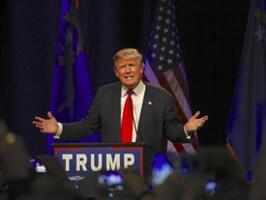
If “The Donald” loses the Republican presidential nomination and runs as a third-party candidate, he definitely could put a crimp in GOP hopes to reclaim the White House.
Rasmussen Reports Rasmussen Reports Managing Editor Fran Coombs or spokesman Leon Sculti are available for media comment on these poll results. Call 732-776-9777x205 or send e-mail toleon.sculti@rasmussenreports.com to schedule now.
When tracking President Obama’s job approval on a daily basis, people sometimes get so caught up in the day-to-day fluctuations that they miss the bigger picture. To look at the longer-term trends, Rasmussen Reports compiles the numbers on a full-month basis, and the results can be seen in the graphics below.
With less than a week to go before the first Republican debate, Rasmussen Reports’ first national presidential survey of Likely GOP Voters this year shows Donald Trump with his biggest lead yet. Now it’s up to the billionaire developer to show voters that he deserves it.
In a recent speech criticizing African political leaders who stay too long in office, President Obama said he could win a third term if he ran for president again but acknowledged that U.S. law does not allow it. Could Obama win again?
The gruesome hits keep coming for the baby butchers of Planned Parenthood. President Obama and his top health officials have one last-ditch response left: Quick, hide behind the imaginary mammogram machine!
As the presidential campaign heats up, and we head into the first debate among the 16 declared Republican candidates, there is an asymmetry between the two political parties.
Republican voters have been seething with discontent toward their party's officeholders and have not become enchanted with any one of 15 more or less conventional politicians who are running. Democratic voters support their officeholders with lockstep loyalty and seem untroubled by the serious flaws of their party's clear frontrunner.
Voters can’t make it much clearer, but apparently President Obama and Congress still don’t get the message.
School textbooks remain a central issue in the cultural battle over America's past, and voters continue to strongly believe most textbooks value political correctness over accuracy.
Going into the first Republican debate of the primary season next week, it looks like Donald Trump, Scott Walker and Jeb Bush are guaranteed seats.
Even though voters don’t have much faith that the country’s best days lie ahead, most still believe America is a good place to live.
Next week begins what has become a regular presidential primary tradition: the debates. As a way of previewing them, we decided to look back at the history of primary debates. Readers may be surprised to learn that primary debates existed before the advent of televised general election debates in 1960. Less surprising is that the number of debates has been steadily increasing over time, although it appears that both parties will have fewer in 2016 than they did in their last competitive primary seasons (2012 for Republicans, 2008 for Democrats).
Voters still tend to think America’s best days are already behind us, but a climbing optimism that they’re still to come remains.
Senator Ted Cruz voiced the unhappiness of many Republican conservatives when he took to the floor of the Senate last Friday and in a rare intraparty broadside accused GOP Senate leader Mitch McConnell of lying. Veteran Republican senators quickly rallied to McConnell’s defense.
The government's environmental rules defeat even environmentalists.
It's the most far-reaching scandal in Washington that no one wants to talk about: Tens of millions of federal employees had their personal information hacked as a result of Obama administration incompetence and political favoritism.
FBI Director James Comey recently announced that the radical Islamic State group (ISIS) now poses a bigger security threat to the United States than al-Qaeda does. Americans appear to agree.
Forty-seven years ago, the musical "Hair" opened on Broadway. Elderly mavens -- the core theater audience then, unlike the throngs of tourists flocking to cheap movie adaptations today -- were instructed that America was entering an "Age of Aquarius." The old moral rules were extinct: we were entering a new era of freedom, experimentation and self-expression.
Two federal inspectors general have asked the U.S. Justice Department to open an investigation into how then-Secretary of State Hillary Clinton handled sensitive information on her private e-mail account. Most voters continue to have national security concerns about Clinton’s behavior but doubt that the federal government will do anything about it.