Optimism About Future Home Values At Record High
For the first time in eight years of tracking, more than half of homeowners see a rising home value in their future.
The United States was born when the Founding Fathers seceded from England.
A senior House Democrat said last week that it was time for House Minority Leader Nancy Pelosi to step down. But only a fifth of Democrats think that’s a good idea.
Polarization among today’s voters is glaringly apparent when they are asked whether the U.S. Constitution should be changed or left alone, with support for the Constitution as is at its lowest level in a decade.
Cue the funeral bagpipes. My fourth health insurance plan is dead.
President Trump called the mass killings in Las Vegas last week “an act of pure evil” when many of his opponents were trying to blame the guns involved instead.
President Trump's new chair of the Council of Economic Advisers, Kevin Hassett, walked into the lion's den last week with his first official speech. He used the moment to pound the leftist Tax Policy Center. It was a wonderful sight.
Support for Columbus Day is at its highest level in several years, but a sizable number of Americans are ready to replace it with Indigenous Peoples’ Day, an idea that’s already caught on in a number of places around the country.
To attend the Indianapolis Colts game where the number of the legendary Peyton Manning was to be retired, Vice President Mike Pence, a former governor of Indiana, flew back from Las Vegas.
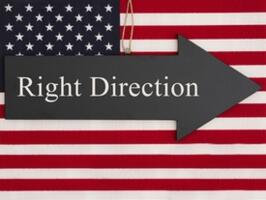
Thirty-two percent (32%) of Likely U.S. Voters now think the country is heading in the right direction, according to a new Rasmussen Reports national telephone and online survey for the week ending October 5.
The mass shooting in Las Vegas has renewed talks of gun-control legislation in Congress, but most voters continue to question the motives of politicians who raise gun-related issues.
As this year’s Nobel Prize winners are being announced, most Americans aren’t paying attention and are evenly split over whether it’s the most prestigious award one can win.
The schizoid character of America these days is captured in two of our latest polls.
No one has ever accused Ross Douthat of excessive astuteness. "Donald Trump isn't going to be the Republican nominee," wrote in January 2016. Dude is paid to prognosticate politics. Even so, Douthat probably pulls down six figures at The New York Times, which doesn't grant me the courtesy of a rejection letter. So people pay attention to him.
Voters see a need for tougher gun regulation following the Las Vegas massacre but remain closely divided over whether it would prevent future mass killings.
What was his motive? Why did he do it?
The overall Rasmussen Reports Economic Index for October rose two points to 129.2. Enthusiasm about the economy started to grow immediately following the 2016 presidential election and continues to show the highest level of confidence since this tracking began in 2014.
Almost no one disagrees that our two major political parties, the oldest and third-oldest in the world, have become increasingly extreme and estranged over the past decade. It's a startling contrast with the state of political conflict in the dozen or so years after the fall of the Soviet empire.
There has been a push for schools to offer more nutritional meals to students to fight the childhood obesity problem that most see as a problem today, and more are now convinced that a lunch meeting nutrition standards should be a requirement in schools.
A majority of voters continue to believe the U.S. Supreme Court should abide by the Constitution, but that number dropped to its lowest level in nearly a decade.